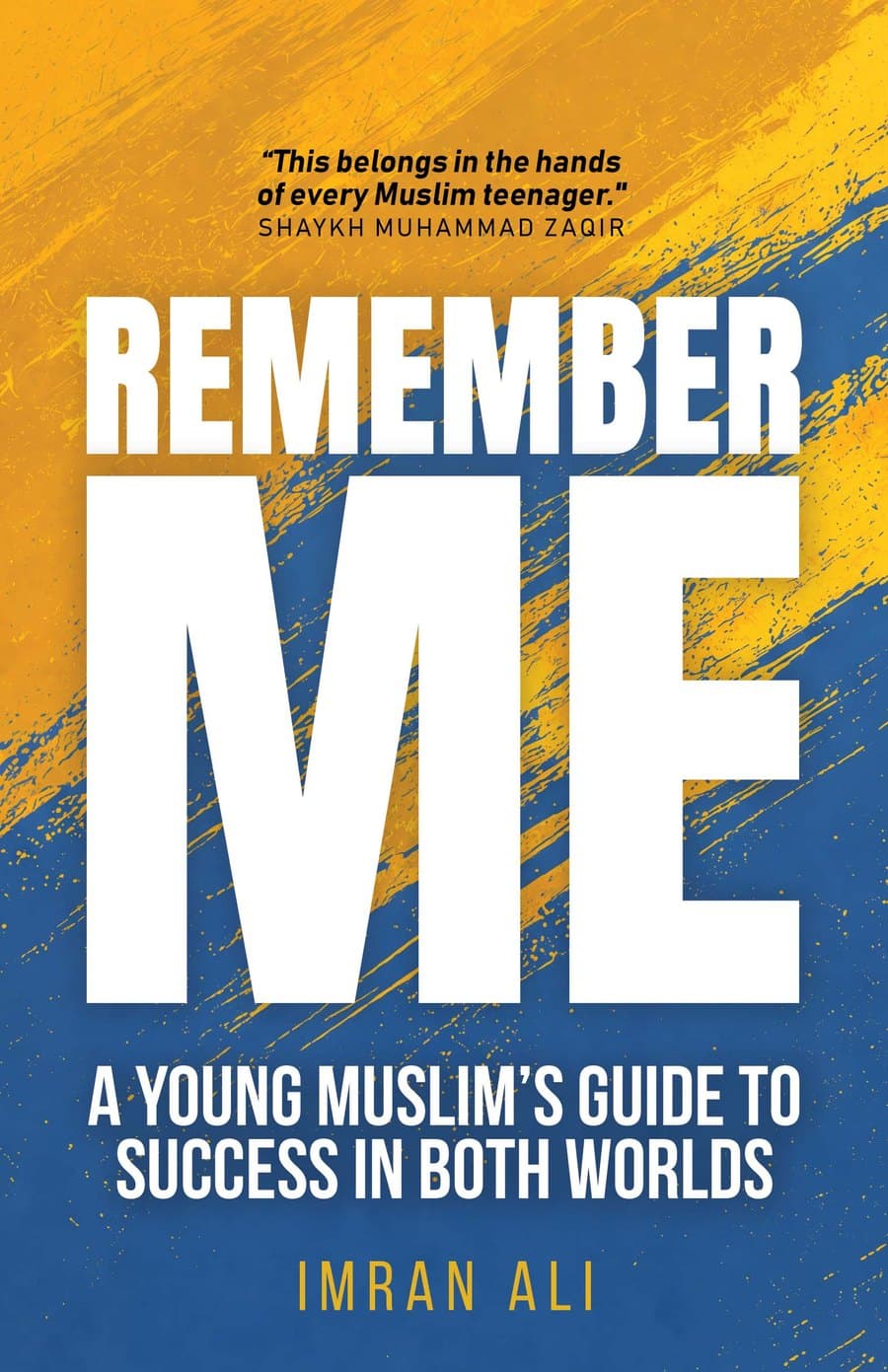
Remember Me
A Young Muslim’s Guide to Success in Both Worlds
All five prayers, up early, no more scrolling, different person from tomorrow. Every teenager has meant it, and every teenager knows how many days it lasted. This is the book that makes the next one hold.
#1 Amazon UK bestseller
- Books on Philosophy for Young Adults
- Body, Mind & Spirit for Young Adults
- Books on Islam for Young Adults
4 September 2026. See the screenshots →
UK £10.00 · US $13.99
What a scholar says
“Very few people can hold a teenager’s attention long enough to teach them anything. Imran is one of the few who can, and I have had him teach our students. Now he has written it down. This belongs in the hands of every Muslim teenager.”
Shaykh Muhammad Zaqir
Founder and Director, Darul Arqam Educational Trust
The promise
A teenager who owns their own choices instead of being surprised by them. Who can tell you why they did what they did, and mean it. Whose promises to themselves start lasting past the first week.
That comes from one thing nobody has handed them yet. There’s a video online explaining how an engine runs, how money moves, how the universe began. There isn’t one for this. With humour, honesty, and not a trace of a lecture, Remember Me gives a young Muslim a map of their own self, the self the Qur’an calls the Nafs, and the way to use it.
UK £10.00 · US $13.99
By the last page
Eight short parts, made to be read one a day. By the end, a young person can:
- catch the moment before they act, while it is still a choice
- see why they slip, and why it says less about them than they think
- run three questions at night and three things in the morning that hold a day together
- see that they never had to choose between winning here and winning in the next life
For the parent buying this
“She already goes to madrasa. Why does she need this?” It’s the fairest question a parent asks, and it deserves a straight answer. The gap isn’t more Qur’an. It’s concepts: how a young person actually works, and why knowing the rules has never been the same thing as being able to keep them.
Think about how a child learns what counts as fair. Not from a lesson. From the air. School, the group chat, the game, the programme running in the background. Individual choice, personal freedom, everyone’s truth being equally true. Nobody argues them into it. It settles the way an accent settles.
Then one day, years later, they meet something in the deen that cuts across it.
Watch the next half-second, because that is the whole thing. They don’t weigh the two against each other. They already know which one is the odd one out. The deen is the thing that sounds unfair, and the ruler they just measured it with never comes up for questioning at all.
That is not a child who lost an argument. That is a child who was never told they were holding a ruler.
And it is not a failure of the madrasa. Your son or daughter may well have spent years there and learned to recite beautifully. But recitation and concepts are different jobs, and the second one was never anybody’s to do. There was no gap in the teaching we grew up with, because the street, the calendar and the whole day around us were quietly teaching the same thing. Our children are learning the same deen in a place where almost nothing agrees with it, and where something in their pocket argues back every few minutes. That is a harder job than we were given, and it is worth saying out loud.
I don’t think the system is broken. I think it needs reform, and that the reform isn’t more content. It’s concepts.
When a pipe bursts in your house you don’t ring round for three quotes. You get it fixed today, at whatever it costs, because the damage is visible and it is happening now.
This is the same damage. It just doesn’t make a sound. There is no wet ceiling to point at, so it never presents as today’s problem, and the years we had to reach them are the ones going past while we file it under things we’ll get to.
None of this is an emergency, and the book isn’t written like one. It gets a teenager to where they decide for themselves what success means, in their own language, before the world decides it for them, and where what they decide actually holds.
What’s inside
Eight Parts. A parent can see the actual architecture of the book in twenty seconds.
- Part 1
The Real Success
Every game they are already playing has a scoreboard somebody else set. This is the one win that doesn’t reset.
- Part 2
The Light You Were Handed
They were given something before they were old enough to ask for it. What it is, and what dims it.
- Part 3
The One Holding the Light
The map: what they are actually made of, and which part of them is doing the deciding.
- Part 4
The Pull
The things they want never did anything to them. A magnet has no hands. The wanting was always theirs, and that turns out to be the good news.
- Part 5
You Didn’t Order That
Their own head says things they would never choose. Why that is not proof of anything about them.
- Part 6
The Road Runs Both Ways
One choice is not a character. Repeated, it becomes one, and it works in both directions.
- Part 7
What Survives Game Over
You can read every book on swimming and still go under. The difference between knowing it and being able to do it.
- Part 8
A Heart That Remembers
They have decided before. This is the system for the day after the deciding wears off.
Questions parents ask
- My teenager doesn’t really read.
- Neither did I. It’s eight Parts, one a day, each one a single sitting. Built for someone who doesn’t finish books.
- Is it for girls as well?
- Yes, and not as a gesture. Two teenagers carry the book the whole way through, Abdul and Amat, and she gets as much of it as he does. Here is how she is introduced: “Most people think she’s fine. That’s one of her actual skills, and it took years to build.” If you have a daughter who says she is just tired and you are not certain you believe her, she is already in this book.
- What if it makes them ask me things I can’t answer?
- Good. The book tells them to write those questions in the margin and take them to somebody who knows more, and it names who: a parent, a teacher, an imam. It starts the conversation. It was never meant to be the last word in it.
- Will it make them feel guilty?
- No, and that is the whole design. It never suggests they didn’t try hard enough. Its argument is that meaning it was never the thing they were missing.
- Is it too religious? Or not religious enough?
- It is rooted in the Qur’an and the authentic Sunnah, and anything touching deeper knowledge goes past people who know more than I do before it reaches a page. It also doesn’t ask a teenager to become somebody else first.
- Can I read it before I give it to them?
- Part One is free, and it is the real thing rather than a sample of it. Most parents know within a few pages whether it’s the one.
UK £10.00 · US $13.99
Who it’s for
Teenagers, boys and girls, from about thirteen. The years of the back end of secondary school, the exams, and working out what comes after them.
It isn’t a book of rulings and it isn’t a study guide. A younger child will find it hard going, and that’s fine. It will still be there.
UK £10.00 · US $13.99
What every copy pays for
A portion of the proceeds from every copy goes to Revive Darul Arqam, the humanitarian arm of the Darul Arqam Educational Trust. They deliver aid in some of the hardest places on earth, Syria and Yemen among them, and they build the kind of giving this book talks about: not one-off handouts, but lasting, self-sustaining projects.
A bread factory baking for refugees year-round. Clean water. Care for orphans.
Revive Darul Arqam is a UK-registered charity, number 1187831.
UK £10.00 · US $13.99
I also come and run sessions for masjids, madrasas, schools and youth groups. What I can run for your group →